

The Case for Browser Engine Diversity
feat. the Ladybird browser
If you look at the browsers we use every day, there seems to be quite a bit of choice. We have Chrome, Edge, Brave, Firefox, Safari, and several others.
But there’s something interesting about this list. Different browsers don’t necessarily mean different browser engines.
For instance, Chrome, Edge, and Brave are all based on Chromium and use its Blink rendering engine. Firefox uses Gecko, while Safari uses WebKit.
This means that despite having several browser choices, a large part of the web is still powered by a relatively small number of browser engines.
Now, there’s a new browser trying to change that.
Ladybird, an independent browser with an engine built entirely from scratch, has just entered alpha. You can now download it for macOS and Linux and try it out yourself.
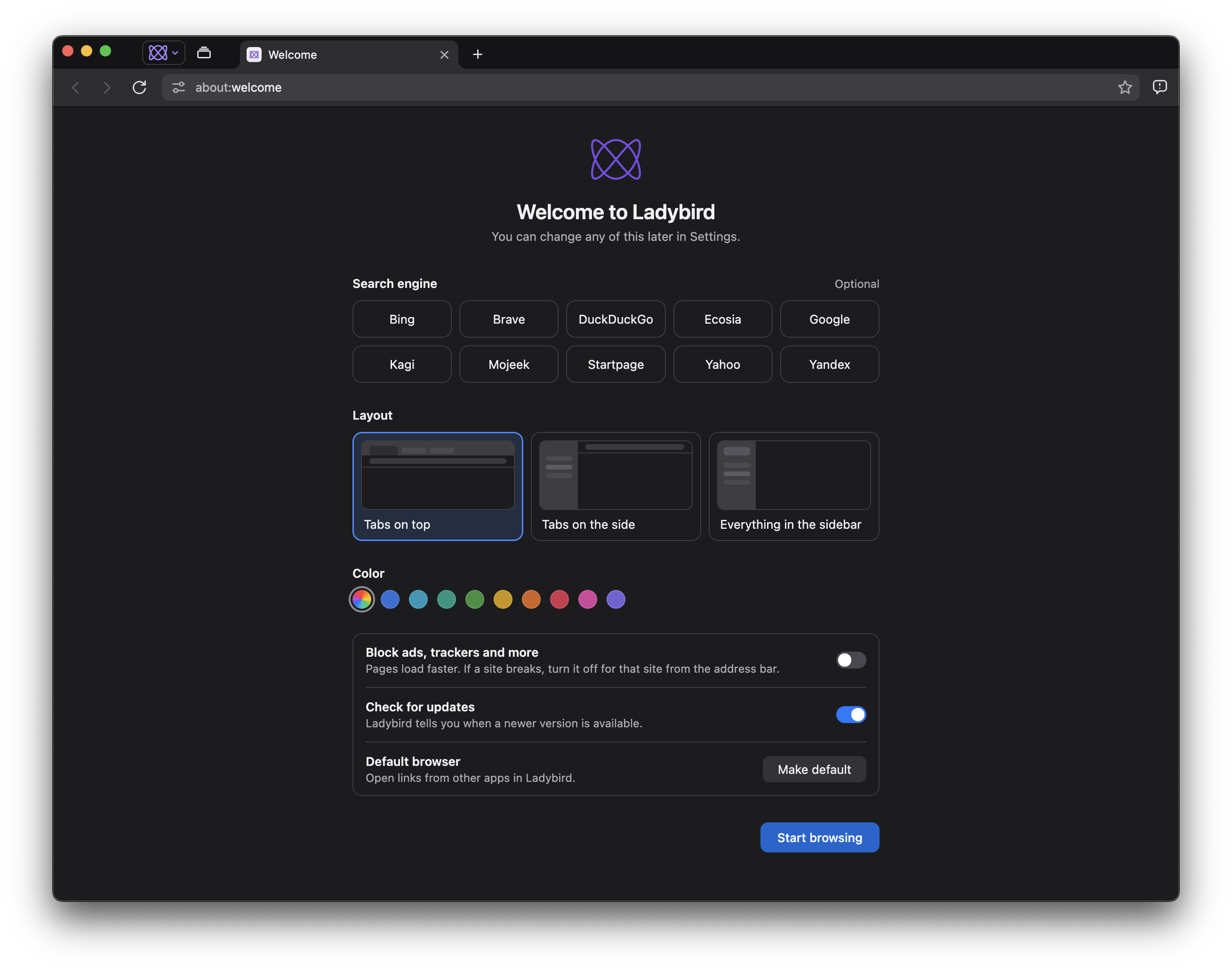
And I think this is particularly interesting news for web developers.
Another browser engine?
The interesting thing about Ladybird isn’t that it’s another browser. It’s that it comes with its own browser engine.
Unlike browsers that build on top of Chromium, WebKit, or Gecko, Ladybird is developing its own implementation of the web platform. It isn’t a fork of any existing browser engine.
The project started as part of SerenityOS and has since evolved into an independent browser initiative. It’s backed by a non-profit organisation and is developed openly.
The browser is still in its early stages, so you shouldn’t expect every website to work perfectly. Some websites won’t work at all, and crashes are expected. The project itself makes no security guarantees at this stage.
But the fact that it’s now available as an alpha release is a meaningful milestone. Until now, trying Ladybird generally meant building it from source. With automatic updates available through its rolling release channel, it’s much easier for developers and early adopters to follow its progress.
You can download it from Ladybird’s website.
Why does browser engine diversity matter?
This is where things get interesting.
When several browsers use the same engine, they share a large part of the implementation responsible for rendering HTML, applying CSS, executing JavaScript, and exposing browser APIs.
That doesn’t mean these browsers behave identically in every situation. They can still differ in their UI, privacy features, browser APIs, and platform integrations.
However, they also share many of the same underlying implementation decisions.
Having more independent browser engines is useful because it gives us another implementation of the web standards to compare against.
For example, imagine a CSS feature that works perfectly in Chromium-based browsers but behaves differently in Firefox. That difference could expose an implementation bug, an ambiguity in the specification, or an assumption made by the developer.
An independent engine gives us another opportunity to catch these things.
This is also why projects like Web Platform Tests and Interop are important. They provide shared tests that browser vendors can use to check whether their implementations behave according to web standards.
The more independent implementations we have, the more valuable this kind of interoperability testing becomes.
Why web developers should pay attention
I think Ladybird is particularly interesting for people who build websites and web applications.
We’ve become accustomed to testing our applications in Chrome, Firefox, Safari, and Edge. But depending on the browsers we choose, we might not actually be testing as many independent browser engines as we think.
Ladybird gives us another implementation to test against.
For instance, you could open your own website in Ladybird and check some of the things you probably take for granted:
- Does the layout render as expected?
- Do your CSS animations and transitions behave correctly?
- Do forms and interactive elements work as intended?
- Are the JavaScript APIs your application depends on implemented?
- Does the website behave correctly when navigating between pages?
You might find something that works perfectly in Chromium and WebKit but behaves differently in Ladybird.
Of course, that doesn’t automatically mean your code is wrong. Ladybird is still an alpha browser, so a missing feature or an implementation bug could be responsible.
Still, finding these differences early is useful. You can reduce the issue to a smaller example and report it to the project, helping improve the implementation.
Ladybird also supports WebDriver for automated testing, along with the Firefox DevTools protocol. This means developers can eventually include it in more automated testing workflows rather than relying entirely on manual testing.
It’s not ready to replace your browser
It’s worth mentioning that Ladybird is still very much a work in progress.
The current alpha is available for macOS and Linux. Windows support is planned for a later stage, while mobile platforms aren’t currently a priority.
Some websites won’t work, and the browser can crash. The project is also actively inviting security researchers to test it and report vulnerabilities. It explicitly makes no security guarantees at this stage.
So, I wouldn’t recommend using it as your everyday browser just yet.
But that’s not really the point of this release. It’s an opportunity for developers and early adopters to try an independent browser engine, see how it handles real websites, and help the project improve.
In Closing
I think Ladybird is a welcome addition to the web ecosystem.
We’ve spent years getting better at making websites work across browsers, but the number of independent browser engines powering those browsers remains relatively small.
Having another implementation is good for the web. It gives us another way to test standards, discover implementation differences, and question assumptions that might have gone unnoticed when most of our testing happens in the same engine family.
Ladybird doesn’t need to replace Chrome, Firefox, or Safari to be valuable. Its existence alone gives the web another independent implementation to learn from.
And for us developers, that’s a good thing.

👋 Hi there! This is Amit, again. I write articles about all things web development. If you enjoy my work (the articles, the open-source projects, my general demeanour... anything really), consider leaving a tip & supporting the site. Your support is incredibly appreciated!